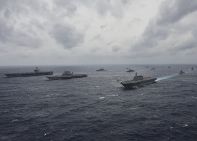
QUAD stands for Quadrilateral Security Dialogue (QSD) or popularly known as Quad. In 2007 the Japanese Prime Minister Shinzo Abe moved an initiative for four countries to come together to counter China’s growing hegemony in the region. These countries are India, Japan Australia and the USA. At that point in time Quad was conceived from a security point of view and hence the start and the endpoint of the cooperation was a yearly Naval exercise attended by the naval ships of the participating navies. It was called Ex Malabar. One has to understand that these were early years of China’s hegemonic designs and global intent. Hu Jintao was in power and China was consolidating the economic gains of the Deng era. The other Heads of States were also inclined to build a friendly and profitable relationship with China. In 2008 Shinzo Abe in Japan was succeeded by Taro Aso, Dr Manmohan Singh was the Prime Minister of India and Australian Prime Minister was Kevin Rudd. All these head of states were hardly antagonistic to China and hence at no point went all out to promote the cause of the Quad. The quad languished at the bureaucratic levels and country after country either left or went cold on the quad agenda. Australia withdrew the very next year from Ex Malabar, i.e. in 2008 and since then had been absent from attending the ex.
The next ten years after the formation of Quad, a lot changed. The principal change was Xi Jinping coming to power in China 2012, Donald Trump coming to power in 2016 and PM Modi coming to power in India in 2014. The US and China immersed in a bitter trade war. It spoiled the geopolitical equations. China started seeing the world through George bush’s prism: ‘either you are with us or you are against us.’ Xi Jinping tried to push the BRI initiative and countries who did not support it were looked as inimical to Chinese interests. China from an engaging power went on to become the expansionary power. The confrontation in the South China Sea with Vietnam and the Philippines, Indonesia and Brunei and many more have annoyed all these Southeast Asian nations. China has grave issues in Hongkong and with Taiwan. All this under the leadership of Xi Jinping, who has assumed greater power in China and now almost put himself in the Power seat for life. He has annoyed the Australians by threatening them of dire consequences if Australia continues as they perceive anti-China policies.
What is at the root cause of this problem? A couple of issues but the major one has been the export of the coronavirus from the Chinese city of Wuhan to the rest of the world. No one that includes the US, Europe Australia India and Japan is willing to let China get away with this unjust act. These countries feel that at least China could have informed the WHO two weeks before about the existence of this virus and that itself would have saved the lives of millions who have died due to corona. As if this was not enough China assumed aggressive posture post the pandemic as if wanting to take advantage of the vulnerabilities they had created through the spread of the virus. China had an aggressive stance against the Vietnamese in the south China sea when the US had to intervene. They launched an ambitious salami-slicing operation in eastern Ladakh against India with a view to annex territory and alter the LAC. China warned Taiwan that it would be wiped out if there is a war with China and Chinese planes and ships have intruded Taiwanese airspace and EEZ as if to coerce them to take actions. All this because Taiwan is cosying up to the US and the general elections in Taiwan were a big success and so has been their fight against corona. China had problems with Mongolia post-pandemic. It threatened Australia of dire consequences because Australians were extremely unhappy about the Chinese export of the virus.
China has practically rubbed everyone who matters in the Indo Pacific on the wrong side post-pandemic. In the post-pandemic world, there is this pressing desire amongst nations to put China in its place. This has given a new life to the Quad and the Indo pacific alignments. Indo Pacific has a great larger construct and goes into issues greater than the Quad. When India announced Ex Malabar 2020, Australia conveyed its desire to participate wholeheartedly in the exercise. Also prior to the exercise, the foreign ministers of the Quad nations met in Japan on the 30-31 of Oct 20. The symbolism of a physical meeting in the times of pandemic where the virtual meeting has become a norm was not lost on anyone. It signalled the urgent desire of the participating nations to strengthen the Quad. Also, it was for the first time that the meeting of the quad got upgraded from bureaucrats to foreign ministers’ level. This will sure give impetus to the quad and encompasses few more issues other than security in the charter of the agreements. Not surprisingly China’s Global Times, their official mouthpiece has equivocally condemned the Quad as an anti-Chinese body.
Ex Malabar 2020; Phase 1, Starts on 03 Nov 20 in the Bay of Bengal and lasts for three days till 06 th of Nov20. In this ship from all the four navies would participate and conduct joint manoeuvres. Due to the pandemic, it’s a non-contact exercise and will display synergy and coordination between the navies based their shared values and commitment to an open and inclusive Indo Pacific and rule-based international order. Phase 2 of the exercise is scheduled in the Arabian sea between 17 to 20 November 20.

Conclusion
It is expected now that the quad would strengthen its bonds and look to expand its scope. The common desire to see the Chinese get a taste of their own medicine will galvanise the Quad nations to participate more actively and take the groups agenda to the next level; economic cooperation. Donald Trump has already declared that he sees the quad as an Asian NATO alliance, so its time Quad ups its status.